Gather like numbers
When we add a long string of numbers, we can simplify the process in this way:
![\begin{align*}&&&5+11+5+5+2+2+5+11+2\\&\text{gather the same numbers:}&&\\&&=&(2+2+2)+(5+5+5+5)+(11+11)\\&\text{write as multiply:}&&\\&&=&3(2) + 4(5) + 2(11)\\&\text{multiply:}&&\\[10pt]&&=&6+20+22\\&\text{add:}&&\\[10pt]&&=&48\end{align}](https://tentotwelvemath.com/wp-content/ql-cache/quicklatex.com-bbd4752e8525d10b56da70f615133e9c_l3.png "Rendered by QuickLaTeX.com")
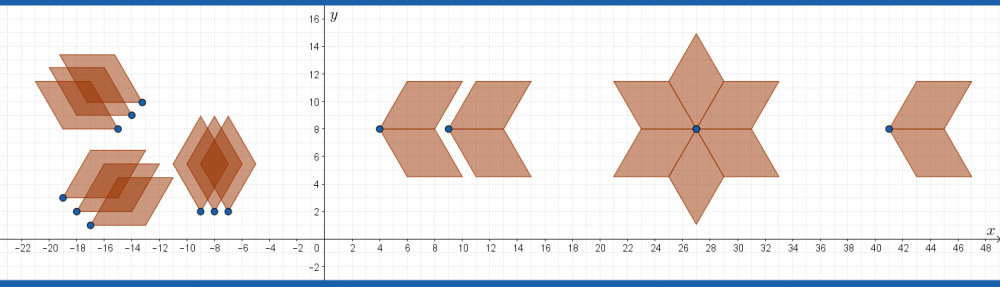
In this exercise gather the same numbers by moving the tiles. Use multiply, then add to calculate the total.
Gather like terms
Terms are numbers, so they work in the same way. The same letter combination means the same value.
Gather the like terms together by moving the tiles. The number of tiles is the coefficient of the term. Write an expression for the total.
(The colour dots at the top tell you the order of terms that the answer uses. The order doesn’t really matter. There are rules to the order, but having the right number of each term is all that matters here.)
After you create an expression, use the values given/chosen for  and
and  to calculate the value of each colour tile and the value of the whole expression.
Simplify before solving
Simplifying an expression is a key skill used when solving equations.
A simplifying move is when you alter the appearance of an of one or both sides of your equation. Neither side changes value. For example:
![\[3x+7x=20\]](https://tentotwelvemath.com/wp-content/ql-cache/quicklatex.com-ed2290139e2058cbd0c9e54a46b52017_l3.png "Rendered by QuickLaTeX.com")
The left hand side simplifies to  . Let’s re-write the equation:
![\[10x=20\]](https://tentotwelvemath.com/wp-content/ql-cache/quicklatex.com-3d9231d08bd89f819e0f26bd186f2ce9_l3.png "Rendered by QuickLaTeX.com")
Notation and definitions
In algebra we represent a number with a single letter.
WHY? Many adults have told me that they lost interest in math when letters showed up, around about now. Why letters?
Here’s an interesting Guardian article on math notation.
We use letters for two reasons – a number is unknown or it is known to change:
1. We know the meaning of the number, but we don’t know the value (unknown).
Eg, the number of gift cards I will sell at the craft fair tomorrow. Suppose I sell a single gift card for 4 dollars. Lets chose the letter  for the number of cards I end up selling. I will make
  dollars, which we write compressed as
  .
.
2. We know the meaning of the number but the number changes (variable).
Eg, My heartrate during a workout at the gym. I know that my heartrate will be between 50 and180 beats per minute (bpm). Let’s choose the letter  for this number. My heartrate will vary between 50 bpm and 180 bpm during the workout.
Definitions
A term is a single number or unknown (a number represented by a letter), or the product (multiplication) of a number with unknowns.
Here are four terms:  .
.
A coefficient is the numerical value in a term.
The coefficient of  is 3.
is 3.
An expression is the addition of one or more terms.
Here is an expression made by adding four terms together:

This expression has two unknowns, represented by and .
Writing two unknowns together means to multiply them, eg  means
means  .
.
If it is given that  and
and  , the value of this expression is:

Note that this expression can be written in any order because addition is commutative:

Gathering in other contexts
We simplify an expression when we collect like terms together. This is like organising the cutlery drawer, or counting a jar full of coins.

https://farm2.static.flickr.com/1431/566441814_6004fe8712_b.jpg
When sorting the coins, we generally sort by the type of coin. E.g. put all the loonies together, the toonies together etc to simplify the final calculation. The denomination of a bank note/coin is its value.
We also organise fractions using the denominator: halfs can be easily added to other halfs, but can’t be easily added to thirds.
In a similar way, terms with letters  can be easily added together, but can’t be easily added to because and have different values.
Examples
Like terms have the same letter combinations. We gather like terms to reduce the number of terms an expression has.
Example 1: To gather like terms, add the coefficients.
![\[7x+5x=12x\]](https://tentotwelvemath.com/wp-content/ql-cache/quicklatex.com-a7ac27246295e9c5a1b5fa2cd16d72e3_l3.png "Rendered by QuickLaTeX.com")
Example 2: Or subtract, if a term is negative:
![\[7x-5x=2x\]](https://tentotwelvemath.com/wp-content/ql-cache/quicklatex.com-b8975c192fea599ba4d808903df00d9f_l3.png "Rendered by QuickLaTeX.com")
Example 3:Note that when a letter appears without a coefficient, the coefficient is 1.
![\begin{align*}&x+7x\\[10pt]=&1x+7x\\[10pt]=&8x\end{align}](https://tentotwelvemath.com/wp-content/ql-cache/quicklatex.com-b1b8bb96f39c40a9efb5ccd1e4e90176_l3.png "Rendered by QuickLaTeX.com")
Example 4: Combine terms with the same letters. Don’t combine terms that have different letter combinations.
![\begin{align*}&5x+3y+4x\\[10pt]=&5x+4x+3y\\[10pt]=&9x+3y\end{align}](https://tentotwelvemath.com/wp-content/ql-cache/quicklatex.com-e62e2417ef55560eefeb59ac7855c0bf_l3.png "Rendered by QuickLaTeX.com")
Example 5: The term  is not like to . Don’t gather these terms.
![\begin{align*}&3x^2+7x+2x^2\\[10pt]=&5x^2+7x\end{align}](https://tentotwelvemath.com/wp-content/ql-cache/quicklatex.com-a1e662ffebab32fb93974ec0b0a2616c_l3.png "Rendered by QuickLaTeX.com")
Example 6: Terms without any letter are called constants and can be added together.
![\begin{align*}&8+3y+2+9y\\[10pt]=&8+2+3y+9y\\[10pt]=&10+12y\end{align}](https://tentotwelvemath.com/wp-content/ql-cache/quicklatex.com-5d12839fa5dcd6bfd6a4cdf612aadea2_l3.png "Rendered by QuickLaTeX.com")
Example 7: The same letter combinations need to stick together:
![\begin{align*}&9xy+5x+2xy+7x\\[10pt]=&(9xy+2xy)+(5x+7x)\\[10pt]=&11xy+12x\end{align}](https://tentotwelvemath.com/wp-content/ql-cache/quicklatex.com-2131c276ddb80ad91581a69f5b308535_l3.png "Rendered by QuickLaTeX.com")