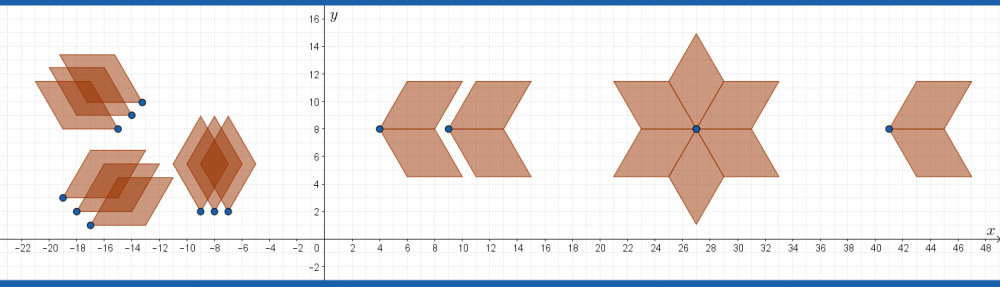
We factor and expand expressions to arrange them into a simpler or more useful form.
Expand brackets
We use brackets (parenthesis) when terms need to be grouped together.
Let’s take the number  , and multiply the whole thing by
  .
.
If we simply say  it looks like we are multiplying
  by 3 and poor 4 is left behind. That’s why we need brackets.
Remember that multiplication is shorthand for repeated addition so let’s decode:

.
The distributive property lets us do this more efficiently:
The distributive property states that  .
.
In other words,

Try it out here:
Factor
To factor a linear expression is to reverse the ‘expand the brackets’ process. To do it we look for a common factor in each term.
We say ‘factor fully’ to make sure we take the greatest common factor from each terms.

Try it out here:
Expand, Simplify, Factor
Simplifying is an important part of handling algebra. To simplify an expression makes our math more efficient and reduces the possibilities for errors.
Remember that simplifying changes how an expression appears (looks) but not its value.