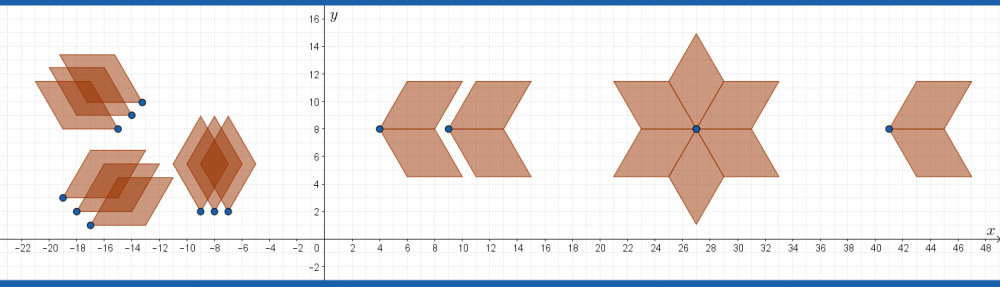
A function is a set of ordered pairs whereby for each element in the first place (domain) there is exactly one element in the second place (range).
When defining a function, it is necessary to consider what values are possible for the domain, in the context of the the purpose of the function. The London Eye ferris wheel provides an example.
We can illustrate the properties of functions using geometry that we are already familiar with. We can:
- calculate ordered pairs and plot them on a graph,
- calculate the algebraic relationship between the two sets of numbers,
- determine what values are valid for the domain of the function,
- calculate the corresponding range,
- draw a graph of the function over the domain specified.
Example: Large and Small Squares
Consider this square that measures 8 cm by 8 cm and has a smaller square of side length  cm cut out of it. How much area is remaining?
The area remaining depends on the value of  .
.
Let’s create a function  that maps the value of to the area remaining, that is,
  .
.
Validity
First, we need to consider what values of are possible in this context.
For a square to exist, we need that  is bigger than (or equal to) zero. We can make sense of ‘no square’ but we can’t make sense, in the context of paper and scissors, of a square that has a negative side length.
We also require that  .
.
Therefore:
![\[0 \leq p+1 \leq 8\]](https://tentotwelvemath.com/wp-content/ql-cache/quicklatex.com-35fe2be169eb771cb809f884afd96201_l3.png "Rendered by QuickLaTeX.com")
in other words,
![\[-1\leq p \leq 7\]](https://tentotwelvemath.com/wp-content/ql-cache/quicklatex.com-7e51eaf7c887458af560fda35e9caf96_l3.png "Rendered by QuickLaTeX.com")
Ordered pairs
Second, let’s calculate some ordered pairs that are part of this function.
When  , the side length of the small square is
  , now
, now  so the area remaining is
  .
.
When  , the side length of the small square is
  , now
, now  so the area remaining is
  .
.
When  , the side length of the small square is
  , now
, now  so the area remaining is
  .
.
and so on….
We can plot the points  on a graph.
Formula
Finally, since we are repeating the same calculation, let’s write it down in general:
We begin with area 64, and subtract the area of the small square.
The area of the small square = 
Therefore, our formula is:
![\begin{align*}R(p)&=64-(p^2+2p+1)\\[10pt]&=64-p^2-2p-1\\[10pt]&=63-2p-p^2\end{align*}](https://tentotwelvemath.com/wp-content/ql-cache/quicklatex.com-1cf8a37f7a2c5d3786af6d4fef20146b_l3.png "Rendered by QuickLaTeX.com")
To write it accurately, we should say:
![\[R(p)=63-2p-p^2, \quad -1\leq p \leq 7\]](https://tentotwelvemath.com/wp-content/ql-cache/quicklatex.com-0f5a0aa8729b5a6b6acfed55f16a63d0_l3.png "Rendered by QuickLaTeX.com")
The graph (click on graph a few times):
To create this graph on GeoGebra, type in or copy/paste: R(p)=63-2p-p^2, -1<=p<=7 to the input bar. To plot the points, you may plot them individually, or you may plot them as a sequence: Sequence[(p,63-2p-p^2),p,-1,7]
Corner Cut Off
A rectangle is made of blue paper and measures 20 cm by 10 cm.
A corner is cut off.
The corner that is cut off is a right angled triangle, with shorter sides  cm and
  cm.
cm.
What values of are valid?
Create a formula  that maps the value p on the slider to the value Hypotenuse.
Create a formula  that maps the value p on the slider to the value Area Remaining.
Check both formula using the value  .
.
Graph your function and your function on Geogebra for the valid values of .
Four Corners Cut Off
Four identical squares are cut from the corners of a piece of blue paper measuring 8 cm by 8 cm.
The side length of one the squares cut off is cm.
What are the valid values of ?
Create a function  that maps the value of p shown on the slider to the Area Remaining, remember to state the domain with the function.
Graph the function for values of in the domain. State the range of the function.
Rectangle in Semi Circle
A rectangle is drawn inside a semi circle that has radius 5 cm.
Find a function that maps the value on the slider to the area of the rectangle.
Graph the function for valid values of . State the domain and the range of the function.
Inscribed Polygon
A regular polygon with p sides is drawn inside a circle with radius 5 as shown.
Show through calculation that the area of the polygon, when p = 7, is 68.41.
Calculate a function that maps the value to the area of the polygon  .
.