Problem solving right triangles with trigonometry means using some of your own ideas to solve multistep or applied problems. It is about transferring your understanding of SOH CAH TOA and the Pythagorean theorem to any question that can be solved using this math.
Sometimes you need to use a combination of SOH CAH TOA math and some other math that you’ve already learned – for example, the area of a triangle or the perimeter of a shape.
Area of a triangle = 
Area of a rectangle = 
Begin by drawing a diagram. Draw your diagram so that the angles look approximately correct. When you draw a right angle, make sure the angle on your drawing looks like a right angle.
Ask questions. Here are some that can be helpful to get started:
- What numerical values are given to me in the question?
- What information am I supposed to be able to calculate?
- What information do I already know how to calculate, even if it isn’t the answer I’m looking for?
Remember to estimate each answer from the diagram before you calculate.
Solve the Triangle.
To ‘solve’ means to calculate all angles or sides that are not already given.
This question might appear challenging at first because you’re not told exactly what to do.
Here is one way to begin:
- Draw a diagram, choose one value to calculate first and call it
 . Label the diagram accordingly and calculate its value.
 - Choose a second value to calculate, and call it
 , calculate.
 - The last value, call it
 and calculate it.
 - Rememberse that the two acute angles in a right angled triangle sum to 90 degrees.
More than Enough Information
In these problems, you are given more information than strictly required. Again, there is more than one correct way to begin. One technique is to cover up one of the values given, which reduces the number of ways the question can be answered.
Isosceles Triangle
Solve the isosceles triangles. Use the information given to calculate the information not given. You are given some of these values, and you are to calculate the others:
- The height,
- The length of the two equal sides,
- The base,
- The size of the two equal angles,
- The third angle,
- The area.
When you draw a diagram of an isosceles triangle, draw on the line of symmetry. Think of the isosceles triangle as two right angled triangles.
Quadrilaterals on a grid
It is possible to calculate the perimeter, area and all four interior angles on a quadrilateral drawn on a grid.
Other Multi-Step Geometry Problems
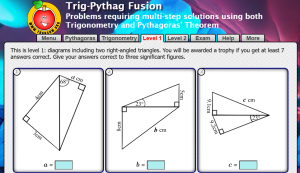
Click on the image to find two pages of multi-step right trangle problems on transum math.
Trees, Ladders, Planes, Flag poles
Click on the image to find right-angled triangle questions set in an excellent variety of contexts.