Here is an example of a system of equations in two unknowns:
![\[\begin{cases}9a+4b=68\\ 5a+b=39 \end{cases}\]](https://tentotwelvemath.com/wp-content/ql-cache/quicklatex.com-a26d75631a47c5abf95b7ce3493e7ef4_l3.png "Rendered by QuickLaTeX.com")
We need to find the value of  and of
  that works in both equations. The solution to this system is
  and
and  . You can check this by substituting the and into the equations:
![\begin{align*}9a+4b&=9(8)+4(-1)=72-4=68\checkmark\\[10pt] 5a+b&=5(8)+(-1)=40-1=39\checkmark \end{align}](https://tentotwelvemath.com/wp-content/ql-cache/quicklatex.com-3c557d3e001f384898dfaf457411180c_l3.png "Rendered by QuickLaTeX.com")
See the details of this solution in Example 1 below.
Khan Academy video:
Worked examples
The goal is to force a ‘match’ between the coefficients of one or the other uknown. A ‘match’ is when the coefficients are equal or have opposite sign of the same number.
Example 1
![\[\begin{cases}9a+4b=68 \\ 5a+b=39 \end{cases}\]](https://tentotwelvemath.com/wp-content/ql-cache/quicklatex.com-e4f75982c168d0cd316c50dbdcdc663a_l3.png "Rendered by QuickLaTeX.com")
Let’s force a match with the coefficient of . Multiply the second equation by 4.
![\[\begin{cases}9a+4b=68\\ 4(5a+b)=4(39) \end{cases}\]](https://tentotwelvemath.com/wp-content/ql-cache/quicklatex.com-2712a3bbeaa5cf4442eb69592c19b463_l3.png "Rendered by QuickLaTeX.com")
leads to:
![\[\begin{cases}9a+4b=68\\ 20a+4b=156 \end{cases}\]](https://tentotwelvemath.com/wp-content/ql-cache/quicklatex.com-6b6d3bb54cb0b8d6d91e625b2245f01d_l3.png "Rendered by QuickLaTeX.com")
Now subtract the first equation from the second equation:
![\begin{align*}(20a+4b)-(9a+4b)&=156-68\\[6pt] 11a&=88\end{align}](https://tentotwelvemath.com/wp-content/ql-cache/quicklatex.com-f633f94f5b30accbcf597bc1e8f05206_l3.png "Rendered by QuickLaTeX.com")
We have eliminated the term! We can now solve for .
![\begin{align*}11a&=88\\[6pt]a&=8\end{align}](https://tentotwelvemath.com/wp-content/ql-cache/quicklatex.com-fe0088a887d5b58c1435f5c011a26b48_l3.png "Rendered by QuickLaTeX.com")
Now solve for . Use either one of the original equations. Substitute
![\begin{align*}5a+b&=39\\[6pt]5(8)+b&=39\\[6pt]40+b&=39\\[6pt]b&=-1\end{align}](https://tentotwelvemath.com/wp-content/ql-cache/quicklatex.com-04cb3e4aba8c1905c178b31ae2f1b5dd_l3.png "Rendered by QuickLaTeX.com")
Finally, substitute our and values into the other equation to check the solution:
![\begin{align*}9a+4b&=68\\[6pt]9(8)+4(-1)&=68\\[6pt]72-4&=68\checkmark\end{align}](https://tentotwelvemath.com/wp-content/ql-cache/quicklatex.com-89294ac3c3910de1dceb92e7851ed741_l3.png "Rendered by QuickLaTeX.com")
Our solutions are 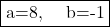
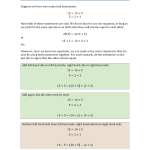
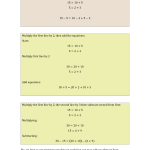
Note: when we ‘subtract equation 1 from equation 2’ we can do this more efficient writing:
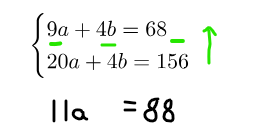
When you solve a system by elimination, you have to make two decisions:
Decision 1: Is there already a ‘match’ or do you need to force one by multiplying?
Decision 2: Should you add or subtract the equations?
Example 2
![\[\begin{cases} m+4n=0\\-m+2n=-6 \end{cases}\]](https://tentotwelvemath.com/wp-content/ql-cache/quicklatex.com-6fcbff9ff91a33b9e1e8f0dabbb56754_l3.png "Rendered by QuickLaTeX.com")
Decision 1: Is there already a ‘match’ or do you need to force one by multiplying?
Answer: There is already a match. The coefficients of  are
are  and
and  in each equation respectively.
Decision 2: Should you add or subtract the equations?
Answer: Since we have opposite signs (plus, minus) we should add the equations.
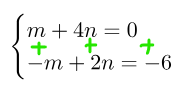
![\[6n=-6\]](https://tentotwelvemath.com/wp-content/ql-cache/quicklatex.com-0e11989887bc6980786bda21fd9e707c_l3.png "Rendered by QuickLaTeX.com")
We have eliminated the term! We can now solve for  .
.
![\begin{align*}6n&=-6\\[6pt]n&=-1\end{align}](https://tentotwelvemath.com/wp-content/ql-cache/quicklatex.com-e3ddf53784c4b6cf268849f994c84551_l3.png "Rendered by QuickLaTeX.com")
Now solve for . Use either one of the original equations and substitute  :
:
![\begin{align*}m+4n&=0\\[6pt]m+4(-1)&=0\\[6pt]m-4&=0\\[6pt]m&=4\end{align}](https://tentotwelvemath.com/wp-content/ql-cache/quicklatex.com-71c7a9c574875ced4a5aea2c3aea3432_l3.png "Rendered by QuickLaTeX.com")
Finally, check your solutions by substituting them both into the other original equation:
![\begin{align*}-m+2n&=-6\\[6pt]-(4)+2(-1)&=-6\\[6pt]-4-2&=-6\checkmark\end{align}](https://tentotwelvemath.com/wp-content/ql-cache/quicklatex.com-6cbfd658d7ae2f1ff9dadd4bc038465f_l3.png "Rendered by QuickLaTeX.com")
Our solutions are 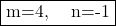
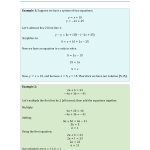
Example 3
![\[\begin{cases}2x-5y=-9 \\3x+4y=44 \end{cases}\]](https://tentotwelvemath.com/wp-content/ql-cache/quicklatex.com-6481f65c4753dc93949029ca1b68f0e2_l3.png "Rendered by QuickLaTeX.com")
Decision 1: Is there already a ‘match’ or do you need to force one by multiplying?
Answer: The isn’t a match. We need to multiply both equations to force a match.
To get a match, choose either the coefficients of the  or of the
  . Let’s choose . The Lowest Common Multiple of 2 and 3 is 6. This is how we get
  in both equations:
![\[\begin{cases}3(2x-5y)=3(-9) \\2(3x+4y)=2(44) \end{cases}\]](https://tentotwelvemath.com/wp-content/ql-cache/quicklatex.com-6f2096ce4897689ec3c2787f3fc853cd_l3.png "Rendered by QuickLaTeX.com")
leads to:
![\[\begin{cases}6x-15y=-27 \\6x+8y=88 \end{cases}\]](https://tentotwelvemath.com/wp-content/ql-cache/quicklatex.com-284077755649b0c1378656af1e0b5758_l3.png "Rendered by QuickLaTeX.com")
Now we have a match with the coefficient of .
Decision 2: Should you add or subtract the equations?
Answer: Since we have the same sign (plus , plus ) we should subtract the equations.
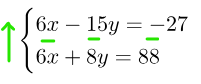
Take care with the ‘double negatives’:
![\begin{align*}(6x-6x)+(8y--15y)&=88--27\\[6pt]23y&=115\\[6pt]y&=5\end{align}](https://tentotwelvemath.com/wp-content/ql-cache/quicklatex.com-bd9796b54572629e569bed8167227e39_l3.png "Rendered by QuickLaTeX.com")
Now substitute  into one of the original equations:
![\begin{align*}2x-5y&=-9\\[6pt]2x-5(5)&=-9\\[6pt]2x-25&=-9\\[6pt]2x&=16\\[6pt]x&=8\end{align}](https://tentotwelvemath.com/wp-content/ql-cache/quicklatex.com-6b15deba8da0dc66ae464e9538d036b5_l3.png "Rendered by QuickLaTeX.com")
Finally substitute and  into the other original equation to check the solutions:
![\begin{align*}3x+4y&=44\\[6pt]3(8)+4(5)&=44\\[6pt]24+20&=44\checkmark\end{align}](https://tentotwelvemath.com/wp-content/ql-cache/quicklatex.com-fe68542291b581333a23abbeed460c95_l3.png "Rendered by QuickLaTeX.com")
Our solutions are 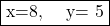
PRACTICE 1
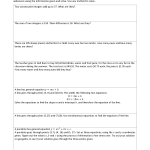
Example problems (with context problems) to print:
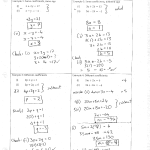
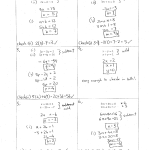
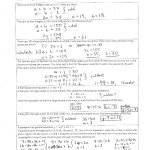
Exercise solutions:
Practice 2
Solve the following systems using elimination. Do your working on paper.
further Learning
Understand the concepts behind the methods.
Concepts for manipulating one equation in one unknown:
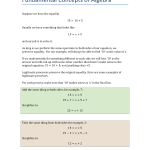
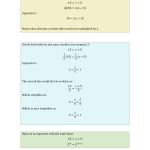
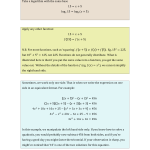
Concepts for manipulating two equations in two unknowns: