A system of equations is a set of equations that can be used together to solve for more than one unknown value.
Two unknowns, two equations
I am often asked the ages of my two kids. Suppose I reply “the sum of their ages is 10 and they are four years apart”.
With this information we can write two equations:
![\[\begin{cases}x+y=10\\ y-x=4 \end{cases}\]](https://tentotwelvemath.com/wp-content/ql-cache/quicklatex.com-bd02ee755d094aa435826b0a90624157_l3.png "Rendered by QuickLaTeX.com")
To solve, we need to find two integers that add together to give 10, then find the one pair where the difference between them is four. Here are all the options for adding to 10, written  :
:
![\[(1,9)\]](https://tentotwelvemath.com/wp-content/ql-cache/quicklatex.com-4653c698cdf01ea6e7da51fefc66a7ba_l3.png "Rendered by QuickLaTeX.com")
![\[(2,8)\]](https://tentotwelvemath.com/wp-content/ql-cache/quicklatex.com-d9cbbc43c6f590dccf16ceb316ca5a63_l3.png "Rendered by QuickLaTeX.com")
![\[(3,7)\]](https://tentotwelvemath.com/wp-content/ql-cache/quicklatex.com-3c77acad95bf7ce4834f2dc6e2e3b7b3_l3.png "Rendered by QuickLaTeX.com")
![\[(4,6)\]](https://tentotwelvemath.com/wp-content/ql-cache/quicklatex.com-6db2234c862b5a0a297cd7a77c283378_l3.png "Rendered by QuickLaTeX.com")
![\[(5,5)\]](https://tentotwelvemath.com/wp-content/ql-cache/quicklatex.com-435a8ef4557cb06dec973932de812ebb_l3.png "Rendered by QuickLaTeX.com")
The only pair that satisfies both equations is  . The younger child is 3 and the older child is 7.
This unit is about how to use graphing and/or algebra to find the values of two unknowns.
Unique Solution
Here is the graph of the two equations about the ages of the two children:
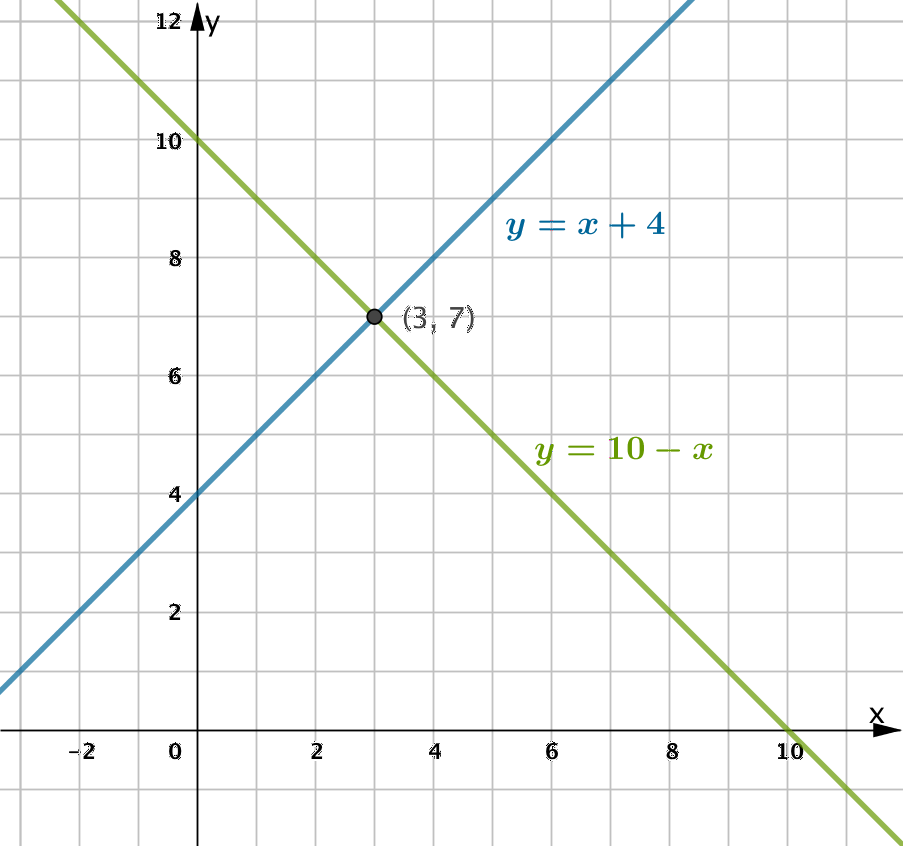
The point is the intersection of the two lines. The intersection of two lines is the only point that lies on both lines.
Finding the solution to two equations in two unknowns boils down to finding the point where the graphs of the two equations intersect. If graphing is not efficient, an algebraic approach can be used.
Identify the solution
Which ordered pair  satisfies both equations? Substitute the
  and
and  of each point to both equations to determine which point is the solution to both. Click on your chosen point.
No Solutions
If our set of equations leads to two lines that are parallel but not coincident, then no ordered pair will satisfy both relations.
![\[\begin{cases}a=b-1\\a=b+4\end{cases}\]](https://tentotwelvemath.com/wp-content/ql-cache/quicklatex.com-7e3459aa010e20d460467f8ba22d25f1_l3.png "Rendered by QuickLaTeX.com")
On a graph:

In this case we can write ‘no solution’ to a system of equations.
Infinitely Many Solutions
When two relations are equivalent, all ordered pairs that satisfy the first will satisfy the second.
Consider
 and
and 
The expression on the right is just a rearrangment of the expression on the left.
Using the relation , we can generate the following ordered pairs:
![\[\{(0,10); (1, 9); (2,8); (5,5); (10,0); (11,-1)\}\]](https://tentotwelvemath.com/wp-content/ql-cache/quicklatex.com-3d1744d6b6efb81de93912d8e8cc4d5d_l3.png "Rendered by QuickLaTeX.com")
…etc
All of those ordered pairs listed also satisfy .
As there are infinitely many points on any line, there are infinitely many ordered pairs that satisfy the system
![\[\begin{cases}y=10-x\\ y+x=10 \end{cases}\]](https://tentotwelvemath.com/wp-content/ql-cache/quicklatex.com-4a2aadd176e7f4cb641686ee957675d4_l3.png "Rendered by QuickLaTeX.com")
In this case we can write one of the two equations as our solution.
Conclusion
When you are presented with a set of equations in this format:
you are required to find an ordered pair that satisfies both equations. Usually, you can find one single ordered pair – a unique solution. However it is also possible that the system has no solution or has infinitely many solutions.
In this unit we practice three techniques for calculating the solutions: graphing (10.7.2); substitution (10.7.3) and elimination (10.7.4).