When multiplying a binomial (an expression with two terms) by another binomial, we end up with four terms..
Example 1: Integers – we can multiply integers using brackets.

Let’s suppose the numbers are actually the length and width of a rectangle.

The total area of this rectangle is the sum of these four calculations:
![\begin{align*}7 \times 30 &= 210\\[10pt]7 \times 4 &= 28\\[10pt]20\times 30&=600\\[10pt]20\times 4 &= 80\end{align*}](https://tentotwelvemath.com/wp-content/ql-cache/quicklatex.com-d039a9ebf3b8ffa8f9c2461113ccea9d_l3.png "Rendered by QuickLaTeX.com")
Which is:  .
.
In other words,  .
.
A binomial multiplied by a binomial yields four terms.
Example 2: In general.
To multiply a binomial by binomial we are multiplying

…where the  and
and  can be any number or variable or mixture of numbers and variables.
Using a rectangle diagram, let the width be  units; the length be
  units.

The total area of the rectangle is  .
.
Example 3:
Multiply  .
.
Here is a rectangle model of this expression:
 Add the four terms:
 .
.
Gather the like terms: 
Therefore,

Example 4: Expand and simplify without drawing a rectangle.
Suppose we wish to expand and simplify:

Everything in the first bracket multiplies everything in the second bracket. We can write this as follows:
![\begin{align*}&(x+2)(x+6)\\[10pt]=&x(x+6)+2(x+6)\\[10pt]=&x^2+6x+2x+12\\[10pt]=&x^2+8x+12\end{align*}](https://tentotwelvemath.com/wp-content/ql-cache/quicklatex.com-a03e0b7f92179dcb8b05c9ce3faffc55_l3.png "Rendered by QuickLaTeX.com")
This technique can be used when multiplying out any brackets. See examples 9 & 10.
Example 5: The algorithm FOIL: First Outside Inside Last
This algorithm helps to calculate all four terms efficiently. It is very nice but can only be used when multiplying two terms by two terms.
We multiply the first terms in each bracket to get 

We multiply the outside terms in each bracket to get 

We multiply the inside terms in each bracket to get 
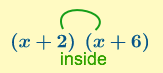
We multiply the last terms in each bracket to get  .
.

Then we add those terms together and simplify to  .
.
Example 6: Watch out!
Remember that a square number means multiply the number by the number? So…
![\[(x-5)^2\]](https://tentotwelvemath.com/wp-content/ql-cache/quicklatex.com-33788c92237b4e81d87a06e067c6a377_l3.png "Rendered by QuickLaTeX.com")
is expanded as follows:
![\begin{align*}&(x-5)^2\\[10pt]=&(x-5)(x-5)\\[10pt]=&x^2-5x-5x+25\\[10pt]=&x^2-10x+25\end{align*}](https://tentotwelvemath.com/wp-content/ql-cache/quicklatex.com-4f35682846fff5b91257955fe1fa3218_l3.png "Rendered by QuickLaTeX.com")
Notice that the answer is not simply  – exponents do not distribute over addition.
Example 7: When the first factor is a whole number:
![\begin{align*}&3(x-10)(2x-1)\\[10pt]=&3(2x^2-x-20x+10)\\[10pt]=&3(2x^2-21x+10)\\[10pt]=&6x^2-63x+30\end{align*}](https://tentotwelvemath.com/wp-content/ql-cache/quicklatex.com-fb02cc62d6fcd972e6e3fb1974eae38a_l3.png "Rendered by QuickLaTeX.com")
alternatively, multiply the three into the first bracket:
![\begin{align*}&3(x-10)(2x-1)\\[10pt]=&(3x-30)(2x-1)\\[10pt]=&6x^2-3x-60x+30\\[10pt]=&6x^2-63x-30\end{align*}](https://tentotwelvemath.com/wp-content/ql-cache/quicklatex.com-2d2cfd717a9eb389c2d113ac592cb5a4_l3.png "Rendered by QuickLaTeX.com")
Example 8: When the first factor is negative one:
![\begin{align*}&-(x-10)(2x-1)\\=&-(2x^2-x-20x+10)\\[10pt]=&-(2x^2-21x+10)\\[10pt]=&-2x^2+21x-10\end{align*}](https://tentotwelvemath.com/wp-content/ql-cache/quicklatex.com-22829646dce67a23aedd922b0dae5373_l3.png "Rendered by QuickLaTeX.com")
Practice
Use paper and pencil before entering your answer.
Applet link: https://www.geogebra.org/m/udx9xygp
Practice Expanding brackets of all kinds on tranum maths: https://www.transum.org/software/SW/Starter_of_the_day/Students/Brackets.asp?Level=9
Example 9: Extending the principle
In example 4 we said that ‘everything in the first bracket multiplies everything in the second.’
The method used in example four can be used for any bracket multiplication. Let’s expand
![\begin{align*}&(x+y+3)(x+2)\\[10pt]=&x(x+2)+y(x+2)+3(x+2)\\[10pt]=&x^2+2x+yx+2y+3x+6\\[10pt]=&x^2+5x+yx+2y+6\end{align*}](https://tentotwelvemath.com/wp-content/ql-cache/quicklatex.com-3dc33d1165a99682a9f7a8d6bbb38433_l3.png "Rendered by QuickLaTeX.com")
Example 10: Three brackets
For three brackets, we simply multiply out the first two then we have two brackets. Etc.
![\begin{align*}&(x+2)(x+3)(x+6)\\[10pt]=&(x^2+3x+2x+6)(x+6)\\[10pt]=&(x^2+5x+6)(x+6)\\[10pt]=&x^2(x+6)+5x(x+6)+6(x+6)\\[10pt]=&x^3+6x^2+5x^2+30x+6x+36\\[10pt]=&x^3+11x^2+36x+36\end{align*}](https://tentotwelvemath.com/wp-content/ql-cache/quicklatex.com-62942498e08e96d2603523d7a2439199_l3.png "Rendered by QuickLaTeX.com")
Try the ten questions at the bottom of this MathisFun page here.