Expressions or numbers that involve exponents can be simplified using these laws:
![\begin{align*}a^m \times a^n &= a^{m+n} \\[10pt] \frac{a^m}{a^n} &= a^{m - n} \\[10pt] (a^m)^n&=a^{mn} \\[10pt] a^1&=a \\[10pt] a^0&=1 \\[10pt] a^{-n}&=\frac{1}{a^n} \\[10pt] (a\cdot b)^n&=a^n \times b^n \\[10pt] \Big(\frac{a}{b}\Big)^n&=\frac{a^n}{b^n}\end{align*}](https://tentotwelvemath.com/wp-content/ql-cache/quicklatex.com-9251be9686d577a6b6af8fd1ba9a1f8e_l3.png "Rendered by QuickLaTeX.com")
Mathantics summary:
The Product Law
Now we know that  . Let’s write that in another way:
![\[7 \times (7 \times 7 \times 7)=7^1 \times 7^3 = 7^4\]](https://tentotwelvemath.com/wp-content/ql-cache/quicklatex.com-df6142fa84c1648f8e654417bc694087_l3.png "Rendered by QuickLaTeX.com")
or
![\[(7 \times 7) \times (7 \times 7)=7^2 \times 7^2 = 7^4\]](https://tentotwelvemath.com/wp-content/ql-cache/quicklatex.com-6087d5073390550a644172dc0dfbbea8_l3.png "Rendered by QuickLaTeX.com")
What we notice about the exponents is that they add up to four.
Let’s take a second example: suppose we have  .
.
Writing that out in full give us:
![\[(7 \times 7 \times 7) \times (7 \times 7\times 7\times 7\times 7)=7^8\]](https://tentotwelvemath.com/wp-content/ql-cache/quicklatex.com-7d07410143ddaee22ead83df23599d16_l3.png "Rendered by QuickLaTeX.com")
.
This leads us to the law for the product of two exponents with the same base: for any values  ,
,  ,
,
![\[7^m \times 7^n = 7^{m+n}\]](https://tentotwelvemath.com/wp-content/ql-cache/quicklatex.com-04cc7ac65f994cd41d885ed0bb559168_l3.png "Rendered by QuickLaTeX.com")
More generally,
![\[a^m \times a^n = a^{m+n}\]](https://tentotwelvemath.com/wp-content/ql-cache/quicklatex.com-6e89449e8584d839f4a4fc1792a13dd6_l3.png "Rendered by QuickLaTeX.com")
The Quotient Law
When a fraction has a common factor on numerator and denominator, it can be simplified. For any number  ,
,
![\[\frac{a}{a}=1\]](https://tentotwelvemath.com/wp-content/ql-cache/quicklatex.com-1823c57f5ac9be73739df3dc8c87b003_l3.png "Rendered by QuickLaTeX.com")
For example:
![\[\frac{18}{21}=\frac{6\times 3}{7 \times 3}=\frac{6}{7}\times\frac{3}{3}=\frac{6}{7}\times 1 = \frac{6}{7}\]](https://tentotwelvemath.com/wp-content/ql-cache/quicklatex.com-ddb6ee4f38fcd82a539230e53fe42b1b_l3.png "Rendered by QuickLaTeX.com")
More briefly:
![\[\frac{18}{21}=\frac{6\times \cancel{3}}{7 \times \cancel{3}} = \frac{6}{7}\]](https://tentotwelvemath.com/wp-content/ql-cache/quicklatex.com-7695cf7f2e2662f16a2be9f1d086b210_l3.png "Rendered by QuickLaTeX.com")
Simplifying fractions leads us to the quotient rule.
![\[7^5 \div 7^3 = \frac{7^5}{7^3}=\frac{7\times 7\times 7\times 7 \times7}{7\times 7\times 7}=\frac{7 \times 7 \times \cancel{7} \times \cancel{7} \times \cancel{7}}{\cancel{7} \times \cancel{7} \times \cancel{7}}=\frac{7^2}{1}=7^2\]](https://tentotwelvemath.com/wp-content/ql-cache/quicklatex.com-49136ef0dbce3606d45a85c09313c919_l3.png "Rendered by QuickLaTeX.com")
We started with the product of 5 sevens, we scored out 3, and we were left with 2. This leads us to the law for the quotient of two powers with the same base:
![\[7^5 \div 7^3=7^{5-3}=7^2\]](https://tentotwelvemath.com/wp-content/ql-cache/quicklatex.com-02de92c27cd7b46801b1fb8920810579_l3.png "Rendered by QuickLaTeX.com")
or, more generally,
![\[a^m \div a^n = a^{m - n}\]](https://tentotwelvemath.com/wp-content/ql-cache/quicklatex.com-4a55a178ccb7a82f6fd23596683d508d_l3.png "Rendered by QuickLaTeX.com")
The Power Law
The power law tells us what do when we have a value expressed with an exponent raised to another exponent:
![\[(7^3)^5=7^3 \times 7^3 \times 7^3 \times 7^3 \times 7^3 = 7^{3+3+3+3+3}=7^{3 \times 5}=7^{15}\]](https://tentotwelvemath.com/wp-content/ql-cache/quicklatex.com-09e0133b5d87eac905d3e517e50ac4ec_l3.png "Rendered by QuickLaTeX.com")
In short,
![\[(a^m)^n=a^{mn}\]](https://tentotwelvemath.com/wp-content/ql-cache/quicklatex.com-9c46284f331e536f99c9864dfe172e22_l3.png "Rendered by QuickLaTeX.com")
.
Exponent Zero
The exponent zero can be considered as the number 1 multiplied by any base no times.
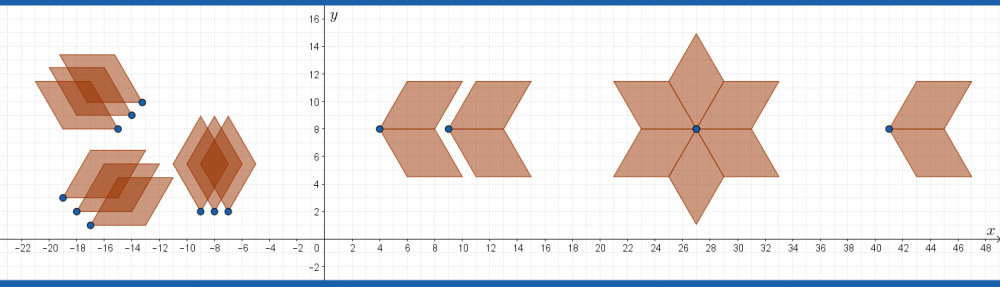
Move the exponent slider to zero for different bases:
The number 1 is implied when we are multiplying. Note that its awkward to say ‘7 times by itself once’. We mean, ‘1 multiplied by 7 once’. Similarly,  means ‘1 multiplied by 7 twice’.
Starting at any exponent of  we can reach all other exponents either by repeated multiplying by 7 or repeated dividing by 7. We can continue multiplying or dividing indefinitely. We can think of the number 1 as being in the middle of it all. 1 is the number 1 multiplied or divided by 7 (or anything) no times.
Here is the pattern:
![\begin{align*}&1\times 7 \times 7 \times 7&=7^3\\[10pt]&1\times 7 \times 7 &=7^2\\[10pt]&1\times 7&=7^1\\[10pt]&1&=7^0\\[10pt]&1\div 7&=7^{-1} \\[10pt]&1\div 7\div 7&=7^{-2}\\[10pt]&1\div7 \div7\div7 &=7^{-3} \end{align*}](https://tentotwelvemath.com/wp-content/ql-cache/quicklatex.com-9210b3026a7113dc27d3a2b2831c52d7_l3.png "Rendered by QuickLaTeX.com")
Another way to consider the exponent zero is with an example like  . We already know that anything divided by itself is just 1. Let’s see what happens when we apply the quotient law:
![\[1=\frac{7^3}{7^3}= 7^3 \div 7^3 = 7^{3-3}=7^0\]](https://tentotwelvemath.com/wp-content/ql-cache/quicklatex.com-da5f79819fda5a43cfe07f08b7748637_l3.png "Rendered by QuickLaTeX.com")
In general,  (with the curious exception of a=0, but only sometimes…).
Negative Exponents
Multiplying by the base once results in adding one to the exponent:
![\[7^4\times 7 = 7^{4+1}=7^5\]](https://tentotwelvemath.com/wp-content/ql-cache/quicklatex.com-594198151543f829e8814b2f3355b06d_l3.png "Rendered by QuickLaTeX.com")
Dividing by the base once results in subtracting one from the exponent:
![\[7^4 \div 7 = 7^{4-1}=7^3\]](https://tentotwelvemath.com/wp-content/ql-cache/quicklatex.com-7a6f7fdfb24934a898a450f39784909f_l3.png "Rendered by QuickLaTeX.com")
If we keep subtracting from the exponent, eventually we will reach a negative exponent:
![\[7^4 \div 7^2 = 7^{4-2}=7^2=49\]](https://tentotwelvemath.com/wp-content/ql-cache/quicklatex.com-319f6220c37544d01524ec13bcaf4e0b_l3.png "Rendered by QuickLaTeX.com")
![\[7^4 \div 7^3 = 7^{4-3}=7^1=7\]](https://tentotwelvemath.com/wp-content/ql-cache/quicklatex.com-d5797a7316b66aef9e58cd52e2472c12_l3.png "Rendered by QuickLaTeX.com")
![\[7^4 \div 7^4= 7^{4-4}=7^0=1\]](https://tentotwelvemath.com/wp-content/ql-cache/quicklatex.com-bec579f69ad5bcbb92948b998fca879f_l3.png "Rendered by QuickLaTeX.com")
![\[7^4 \div 7^5= 7^{4-5}= 7^{-1}=\frac{1}{7}\]](https://tentotwelvemath.com/wp-content/ql-cache/quicklatex.com-1a88cdd1dd7074d919df0068e62a186f_l3.png "Rendered by QuickLaTeX.com")
![\[7^4 \div 7^6= 7^{4-6}= 7^{-2}=\frac{1}{7^2}\]](https://tentotwelvemath.com/wp-content/ql-cache/quicklatex.com-8d9a6dcfd5e5ca62761ebf19be0f7023_l3.png "Rendered by QuickLaTeX.com")
Note in the last line,
![\[7^4 \div 7^6 =7^{-2}\]](https://tentotwelvemath.com/wp-content/ql-cache/quicklatex.com-25c1079b7e58364d739feb35d84aa1d5_l3.png "Rendered by QuickLaTeX.com")
Also,
![\[\frac{7^4}{7^6}=\frac{\cancel{7}\times \cancel{7} \times \cancel{7}\times \cancel{7}}{\cancel{7}\times \cancel{7} \times \cancel{7}\times \cancel{7}\times 7 \times 7}= \frac{1}{7^2}\]](https://tentotwelvemath.com/wp-content/ql-cache/quicklatex.com-dbd7546c449651eeec75d903c3470d75_l3.png "Rendered by QuickLaTeX.com")
In other words:
![\[7^{-2}=\frac{1}{7^2}\]](https://tentotwelvemath.com/wp-content/ql-cache/quicklatex.com-1915beaa0149232ba06e0b6a89562baf_l3.png "Rendered by QuickLaTeX.com")
In general, a negative exponent is an instruction to divide.
![\[a^{-n}=\frac{1}{a^n}\]](https://tentotwelvemath.com/wp-content/ql-cache/quicklatex.com-9391c45c8821dfcde8b9d81e3c2323e4_l3.png "Rendered by QuickLaTeX.com")
The set of calculations above can be written as follows:
![\[7^4 \div 7^2 = 7^4\times 7^{-2}=7^{4-2}=7^2=49\]](https://tentotwelvemath.com/wp-content/ql-cache/quicklatex.com-51ff6dfcdd64e2e4bdc39b8560450906_l3.png "Rendered by QuickLaTeX.com")
![\[7^4 \div 7^3 = 7^4 \times 7^{-3}=7^{4-3}=7^1=7\]](https://tentotwelvemath.com/wp-content/ql-cache/quicklatex.com-3745447d84e449be7233b99550a9532b_l3.png "Rendered by QuickLaTeX.com")
etc
When can a value expressed with an exponent be a negative? (Less than zero)
Example:
![\[3^{-5}=1\div 3\div3\div3\div3\div3 =\frac{1}{3^5}=\frac{1}{243}\]](https://tentotwelvemath.com/wp-content/ql-cache/quicklatex.com-7a063f6033564ed3e37c2f90db91bd6e_l3.png "Rendered by QuickLaTeX.com")
The fraction  is a positive number.
On the other hand, if the base is negative and the exponent is an odd number, the value is negative.
![\[(-3)^5=(-3)(-3)(-3)(-3)(-3)=(9)(9)(-3)=81(-3)=-243\]](https://tentotwelvemath.com/wp-content/ql-cache/quicklatex.com-0fb8e2d3287ac92376925552cbbaf55b_l3.png "Rendered by QuickLaTeX.com")
Distribution over a Product or Quotient
Now suppose we have the number  , we know the answer is 100. Let’s write the number 10 as a product and then square it:
![\[(5 \times 2)^2=(5\times2) \times (5 \times 2)= 5 \times 2 \times 5 \times 2 = 5\times 5 \times 2 \times 2 = 5^2 \times 2^2 = 25 \times 4 = 100\]](https://tentotwelvemath.com/wp-content/ql-cache/quicklatex.com-f6a89e006a934942ef28065a71ad40d7_l3.png "Rendered by QuickLaTeX.com")
In other words,
![\[(5 \times 2)^2= 5^2 \times 2^2\]](https://tentotwelvemath.com/wp-content/ql-cache/quicklatex.com-dc89f05097efae93a1db810ef919923b_l3.png "Rendered by QuickLaTeX.com")
This example illustrates that, in general:
![\[(a\cdot b)^n=a^n \times b^n\]](https://tentotwelvemath.com/wp-content/ql-cache/quicklatex.com-285c18ea3b2fb2e1ff9c9640f27b22d0_l3.png "Rendered by QuickLaTeX.com")
Similarly, with division:
![\[\Big(\frac{10}{2}\Big)^2=\Big(\frac{10}{2}\Big)\times \Big(\frac{10}{2}\Big)=\frac{10^2}{2^2}\]](https://tentotwelvemath.com/wp-content/ql-cache/quicklatex.com-53c0c25878201ce5a47804280aa2243c_l3.png "Rendered by QuickLaTeX.com")
In general,
![\[\Big(\frac{a}{b}\Big)^n=\frac{a^n}{b^n}\]](https://tentotwelvemath.com/wp-content/ql-cache/quicklatex.com-4229779cf7b0da1d34a09152635ec76f_l3.png "Rendered by QuickLaTeX.com")
Take Care though – an exponent does not distribute over addition/subtraction!
Example:
![\[7^2=49\]](https://tentotwelvemath.com/wp-content/ql-cache/quicklatex.com-13f267a98cd2831158ea48d991e65cdc_l3.png "Rendered by QuickLaTeX.com")
![\[\big(3+4\big)^2=(3+4)(3+4)=7 \times 7 =49 \checkmark \]](https://tentotwelvemath.com/wp-content/ql-cache/quicklatex.com-95de3741af8a2b5a64826c46928fda71_l3.png "Rendered by QuickLaTeX.com")
The common mistake would be to say that  is equal to
  but lets figure that out:
  which is not 49, so that is simply wrong.
Practice
Summary
Click to open the summary!
Number Sense Question:
What might the value of  be? What meaning does it have? If the math on this page extends to exponents that are not integers, what is the value of
  ?
?
What about  ? Does it have any meaning?
See if your calculator can make sense of and .