The completed square form can be used to:
- Locate the vertex of a parabola, both
 and
and  coordinates;
 - Solve a quadratic equation;
- Calculate the inverse of a quadratic function – discussed in the grade 12 curriculum.
A Perfect Square
 is known as a perfect square because it can be expressed as a single term squared:
![\[x^2+8x+16=(x+4)^2\]](https://tentotwelvemath.com/wp-content/ql-cache/quicklatex.com-9c6adabb1763bc777ef5313280f0948b_l3.png "Rendered by QuickLaTeX.com")
We can confirm this by multiplying out the brackets on the right hand side:
![\[(x+4)^2=(x+4)(x+4)=x^2+4x+4x+16=x^2+8x+16\]](https://tentotwelvemath.com/wp-content/ql-cache/quicklatex.com-1c7c6809bdfba7481fa42fb458432e01_l3.png "Rendered by QuickLaTeX.com")
 is almost a perfect square. It is just one unit more than
  . It can be written:
![\[x^2+8x+17=(x+4)^2+1\]](https://tentotwelvemath.com/wp-content/ql-cache/quicklatex.com-475dd939ff80b2c5fab3874cb45c6505_l3.png "Rendered by QuickLaTeX.com")
‘Completing the square’ is to assume that your quadratic expression is a perfect square, and then to make an adjustment so that the constant term is correct.
Remember that in general, a perfect square has the form  . (Assuming
  .)
.)
Suppose the following are perfect squares – what is the constant  ?
?


![\begin{align*}&\text{1.}\,\,\frac{10}{2}=5,\quad c=5^2=25, \quad x^2+10x+25=(x+5)^2\\[10 pt]&\text{2.} \,\,\frac{8}{2}=4,\quad c=4^2=16, \quad x^2-8x+16=(x-4)^2\\[10 pt]&\text{3.} \,\,\frac{24}{2}=12,\quad c=12^2=144, \quad x^2+24x+144=(x+12)^2\end{align}](https://tentotwelvemath.com/wp-content/ql-cache/quicklatex.com-f6e2abd9a17a9f9648ae97253d4745f0_l3.png "Rendered by QuickLaTeX.com")
Completing the Square when 
When the coefficient of the  term we can write the quadratic expression
  in completed square form using this process:
- half the coefficient
 , and write
  ;
; - subtract the square of
 , to write
  ;
; - Add the original constant and simplify,
 .
.
For example:
- half the coefficient
 , write
  . This is equal to ;
 - subtract the square of
 : write
  This is equal to
  ;
; - Add the original constant and simpilfy:
 This is equal to .
These three steps can all be done in one line:
![\[x^2+8x+17=(x+4)^2-16+17=(x+4)^2+1\]](https://tentotwelvemath.com/wp-content/ql-cache/quicklatex.com-8c24d2f4612dcacad3741a61e12ccba8_l3.png "Rendered by QuickLaTeX.com")
Example 1

Half of  is
is  ;
;  .
.
![\[x^2+10x+1=(x+5)^2-25+1=(x+5)^2-24\]](https://tentotwelvemath.com/wp-content/ql-cache/quicklatex.com-6979af57423e01b95f671c442279f633_l3.png "Rendered by QuickLaTeX.com")
For brain muscle memory: ‘half the coefficient , subtract its square, remember original constant’.
Example 2
![\[x^2-6x+12\]](https://tentotwelvemath.com/wp-content/ql-cache/quicklatex.com-8f65133d7dbf8b5c6aeee5c938a4491e_l3.png "Rendered by QuickLaTeX.com")
Half of  , is
, is  , the square of is
  .
.
![\[x^2-6x+12=(x-3)^2-9+12=(x-3)^2+3\]](https://tentotwelvemath.com/wp-content/ql-cache/quicklatex.com-19575c41dbc820463638f5e51aacfd78_l3.png "Rendered by QuickLaTeX.com")
To check that the right hand side is equal to the left hand side, lets multiply out and simplify:
![\begin{align*}&(x-3)^2+3\\[10 pt]&=(x-3)(x-3)+3\\[10 pt]&=x^2-6x+9+3\\[10 pt]&=x^2-6x+12 \quad \checkmark\end{align}](https://tentotwelvemath.com/wp-content/ql-cache/quicklatex.com-1d8d1d9736d93b7844f28fb65c9d3ca5_l3.png "Rendered by QuickLaTeX.com")
Example 3
‘half the coefficient of , subtract its square’
![\begin{align*}&x^2+6x-4\\[10 pt]=&(x+3)^2-9-4\\[10 pt]=&(x+3)^2-13\end{align}](https://tentotwelvemath.com/wp-content/ql-cache/quicklatex.com-25637d5d6fe3fdd0227a0e7fbe4711d2_l3.png "Rendered by QuickLaTeX.com")
Example 4, odd coefficient of
![\begin{align*}&x^2+7x-1\\[10 pt]=&\left(x+\frac{7}{2}\right)^2-\frac{49}{4}-1\\[10 pt]=&\left(x+\frac{7}{2}\right)^2-\frac{49}{4}-\frac{4}{4}\\[10 pt]=&\left(x+\frac{7}{2}\right)^2-\frac{53}{4}\end{align}](https://tentotwelvemath.com/wp-content/ql-cache/quicklatex.com-5a2f4178eb30acab95d014cc24c91c77_l3.png "Rendered by QuickLaTeX.com")
Practice
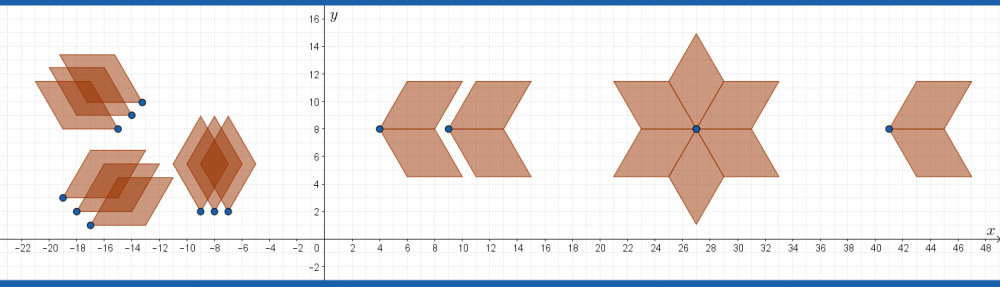
Use this applet to develop muscle memory for the complete the square process:
When the coefficient of is not 1
How we complete the square depends if we are solving an equation or rewriting an expression.
If we have an equation, we can divide both sides by the coefficient  :
:
![\begin{align*}&3x^2-4x-5=0\\[10 pt]\Rightarrow &x^2-\frac{4}{3}x-\frac{5}{3}=0\end{align}](https://tentotwelvemath.com/wp-content/ql-cache/quicklatex.com-8cf617d0b6a53e9e89c10d94567382c5_l3.png "Rendered by QuickLaTeX.com")
(remember that  ). The rest of this work is detailed in Example 4 on another page.
If we have an expression, we need to factor the coefficient of :
![\begin{align*}&3x^2-4x-5\\[10 pt]=&3\left(x^2-\frac{4}{3}x-\frac{5}{3}\right)\end{align}](https://tentotwelvemath.com/wp-content/ql-cache/quicklatex.com-48bec7eb8de1a6dec2e89e89f991ad66_l3.png "Rendered by QuickLaTeX.com")
We can then complete the square within the large brackets:
![\begin{align*}&3\left(x^2-\frac{4}{3}x-\frac{5}{3}\right)\\[10 pt]=&3\left(\left(x-\frac{2}{3}\right)^2-\left(\frac{2}{3}\right)^2-\frac{5}{3}\right)\\[10 pt]=&3\left(\left(x-\frac{2}{3}\right)^2-\frac{4}{9}-\frac{15}{9}\right)\\[10 pt]=&3\left(\left(x-\frac{2}{3}\right)^2-\frac{19}{9}\right)\\[10 pt]=&3\left(x-\frac{2}{3}\right)^2-\frac{19}{3}\end{align}](https://tentotwelvemath.com/wp-content/ql-cache/quicklatex.com-4c29e4b23c41eb397c2829bf494275c2_l3.png "Rendered by QuickLaTeX.com")
This algebra is fairly tricksome and can take some practice to master. However, in a pinch, one might wish to use the following:
Using the Vertex to Complete the Square
On another page, we argue that if  , the vertex has coordinates
  . We can find the values
  and
and  using any ‘find the vertex’ method.
On a different page, we see that 
Considering our example above,  ,
,  . Therefore,
  .
.
To find  we simply need to substitute
  to the expression:
![\[3\left(\frac{2}{3}\right)^2-4\left(\frac{2}{3}\right)-5=\frac{4}{3}-\frac{8}{3}-\frac{15}{3}=\frac{-19}{3}\]](https://tentotwelvemath.com/wp-content/ql-cache/quicklatex.com-cd899e964c37ee97006c32877388b2af_l3.png "Rendered by QuickLaTeX.com")
Therefore  .
.
After calculating and , ( ), we have
![\[a(x-h)^2+k=3\left(x-\frac{2}{3}\right)^2-\frac{19}{3}\]](https://tentotwelvemath.com/wp-content/ql-cache/quicklatex.com-5d565b449cb5d11c84fe2d60f9bb9d66_l3.png "Rendered by QuickLaTeX.com")
which agrees with the algebra above.